An article that exists partly to say clearly that one compound in this catalog has a documented safety problem.
In short
- The melanocortin family signals through five receptors, MC1R to MC5R, with distinct distributions — MC1R in melanocytes, MC4R in the central nervous system.
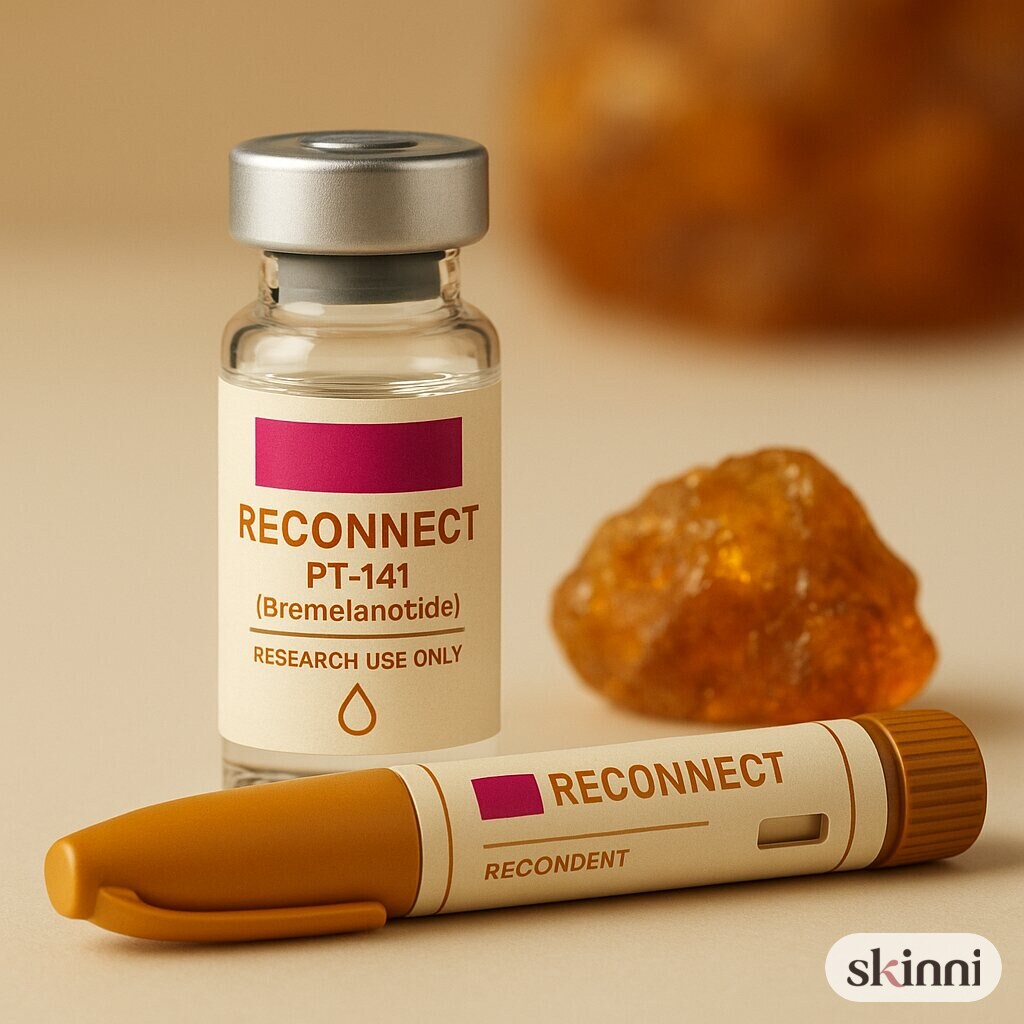
- Bremelanotide is a melanocortin receptor agonist that completed two randomised phase 3 trials, published by Kingsberg and colleagues in 2019, and is an approved drug for a named indication.
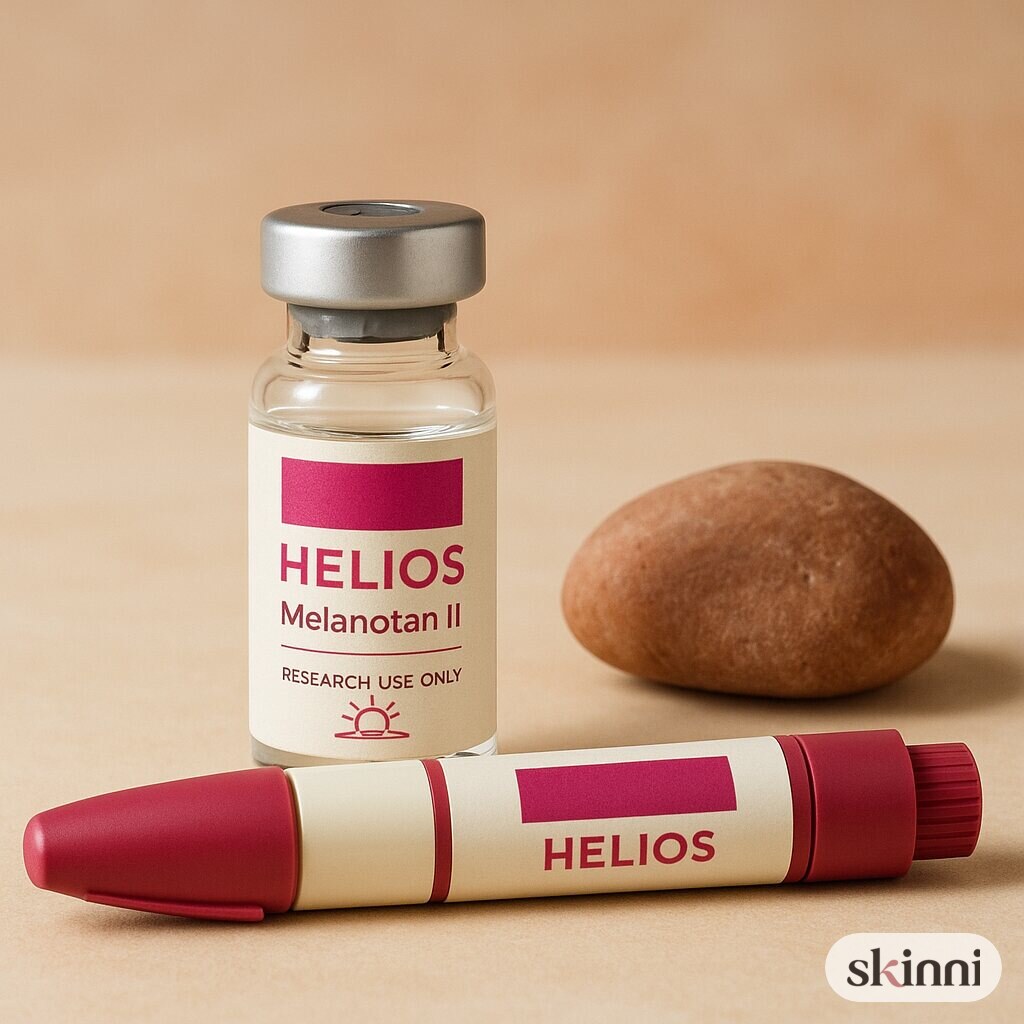
- Melanotan II is a non-selective cyclic analogue whose human record consists of small early studies plus a substantial case-report literature of adverse events.
- Several national regulators have issued public warnings about unlicensed melanotan products. Any honest account of this compound leads with that.
One family, five receptors
The melanocortins — alpha-, beta- and gamma-MSH and ACTH — are all cleaved from the same precursor, proopiomelanocortin, and signal through five G-protein-coupled receptors with sharply different distributions. MC1R sits on melanocytes and governs pigmentation. MC2R is the adrenal ACTH receptor. MC3R and MC4R are central, with MC4R heavily implicated in energy balance — loss-of-function mutations in MC4R are among the more common monogenic causes of severe early-onset obesity. MC5R is peripheral, associated with exocrine function.
Receptor selectivity therefore determines almost everything about a melanocortin analogue's behaviour. A compound that does not discriminate between MC1R and MC4R is acting on pigmentation, central appetite circuitry and cardiovascular regulation simultaneously, and there is no way to engage one of those without the others.
Bremelanotide, and what a phase 3 programme produced
Bremelanotide is a cyclic heptapeptide melanocortin receptor agonist, developed after work on an earlier compound in the same family, with central MC4R activity understood as the relevant mechanism for its indication.
Kingsberg, Clayton, Portman and colleagues published the two identically designed randomised, placebo-controlled phase 3 trials — the RECONNECT programme — in Obstetrics and Gynecology in 2019, in premenopausal women with hypoactive sexual desire disorder, with co-primary endpoints on validated desire and distress instruments. Both trials reported statistically significant improvement on the co-primary endpoints relative to placebo. Nausea was the most frequently reported adverse event, and transient blood-pressure elevation was documented. The compound was subsequently approved for that indication.
As with tesamorelin in the endocrine article, the scope of what that establishes is narrow and specific: one population, one indication, validated instruments, an approval bounded accordingly.
Melanotan II, stated plainly
Melanotan II is a cyclic non-selective alpha-MSH analogue. Its human record is thin and its adverse-event record is not. The published literature includes case reports of eruptive and changing melanocytic naevi, reports of melanoma diagnosed in users, rhabdomyolysis, renal infarction, priapism and systemic reactions, largely in people using unlicensed product obtained outside any medical setting.
National regulators have acted on this. Medicines agencies in several countries, including the UK's MHRA and counterparts in Europe and Australia, have issued public warnings against unlicensed melanotan products, and the compound is not approved for any indication anywhere in the mainstream regulatory landscape. The non-selectivity described above is the mechanistic reason the adverse-event profile is as broad as it is.
The compound appears in this catalog as a research compound for melanocortin receptor pharmacology, which is a legitimate research object and is what the page says. It carries the same research-use restriction as everything else here, and in its case that restriction is load-bearing rather than formal. Anyone reading a summary of this compound that omits the regulatory warnings should treat the omission as information about the source.
Why both are in one world
The Specialty world exists for research targets that do not group with the others — pigmentation signalling being the clearest example. What that grouping does not imply is a shared level of evidence or a shared safety picture, and this pair is the sharpest illustration of that point anywhere in the catalog.
Neither page carries dosing or a route of administration. Neither describes an effect in a person outside the trials named above.
References
- Kingsberg SA, Clayton AH, Portman D, et al.. Bremelanotide for the treatment of hypoactive sexual desire disorder: two randomized phase 3 trials. Obstetrics & Gynecology. 2019;134(5):899–908.
- Medicines and Healthcare products Regulatory Agency. Public warnings on unlicensed melanotan products. MHRA drug safety communications.
What this article is, and is not
This is a summary of published research, written for qualified professionals evaluating compounds for laboratory work. Every compound discussed is supplied by strictly for in-vitro and laboratory research use. None is a drug, a dietary supplement, or a cosmetic; none is intended for human or veterinary use; and nothing above is medical advice, a treatment recommendation, or a claim that any compound produces any effect in a person. We publish no dosing or administration guidance of any kind.