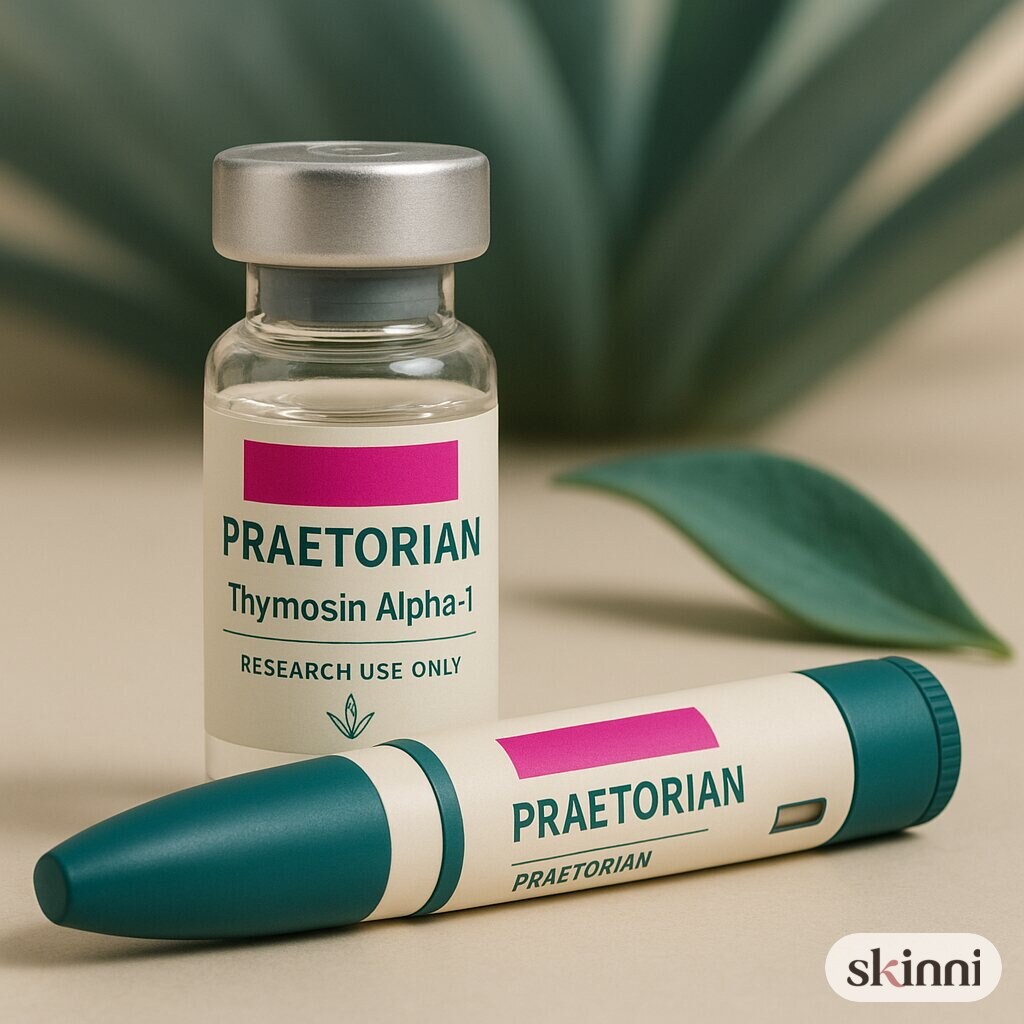
One of the older research peptides still in active use, and what fifty years of literature does and does not settle.
In short
- Thymosin alpha-1 is a 28-residue peptide originally isolated from thymic tissue fraction 5.
- Its described mechanism centres on Toll-like receptor signalling in dendritic cells and on downstream T-cell differentiation.
- It is licensed in a number of countries as an immunomodulator, principally in viral hepatitis and as a vaccine adjuvant, and is not approved in the United States.
- Garaci's historical overview in 2007 traces the line from thymic extract to a defined synthetic peptide.
From an extract to a sequence
The thymus was understood to be immunologically necessary well before anyone knew what it secreted. Work through the 1960s and 1970s fractionated thymic tissue in search of the active principle, and thymosin alpha-1 was isolated from the preparation known as fraction 5 — a 28-residue, N-terminally acetylated peptide that turned out to be the fragment carrying much of the activity attributed to the extract.
Garaci's overview in the Annals of the New York Academy of Sciences in 2007 traces that arc, which is a useful corrective to the assumption that research peptides are a recent phenomenon. This one has been synthesised, characterised and clinically studied for around fifty years.
The mechanistic account
The current mechanistic picture places thymosin alpha-1 upstream in innate-to-adaptive signalling rather than acting directly on a single effector population. Reported activity centres on Toll-like receptor signalling in dendritic cells, with downstream consequences for T-cell differentiation and for the cytokine environment in which that differentiation happens.
Published work also describes effects on natural killer cell activity and on macrophage function — a 2019 report in Frontiers in Immunology examined complement-receptor-mediated phagocytosis in human monocyte-derived macrophages. Reviews collating the viral-infection literature, including a 2023 review in Molecules, frame the compound as modulating an immune response rather than stimulating it uniformly, which is the relevant distinction for a molecule studied in both infectious and oncological contexts.
The consistent theme across the reviews is that effects are context-dependent — the same compound reported to increase or restrain a given readout depending on the baseline immune state of the model.
Regulatory status, precisely
Thymosin alpha-1 is licensed as an immunomodulator in a number of countries, with hepatitis B and C and use as a vaccine adjuvant among the indications, and it has been studied in sepsis and in oncology settings. It is not approved by the FDA, and in 2019 it was among the substances the agency identified as difficult to characterise adequately for use in compounded preparations.
Both halves of that are worth stating together. This is a compound with a real clinical literature and real approvals in some jurisdictions, and it is also not an approved drug in the United States. Conflating the two in either direction misrepresents it.
In the catalog
Thymosin alpha-1 sits in the Cellular world, with immune signalling named as the research target alongside the mitochondrial and redox entries. The grouping is by research question rather than by mechanism, and this compound's mechanism is not the mitochondrial one.
As everywhere on this site, the page names what investigators study and carries no dosing, no route, and no claim of an effect in a person.
References
- Garaci E. Thymosin alpha-1: a historical overview. Annals of the New York Academy of Sciences. 2007;1112.
- Tao N, Xu X, Ying Y, et al.. Thymosin alpha-1 and its role in viral infectious diseases: the mechanism and clinical application. Molecules. 2023;28(8):3539.
What this article is, and is not
This is a summary of published research, written for qualified professionals evaluating compounds for laboratory work. Every compound discussed is supplied by strictly for in-vitro and laboratory research use. None is a drug, a dietary supplement, or a cosmetic; none is intended for human or veterinary use; and nothing above is medical advice, a treatment recommendation, or a claim that any compound produces any effect in a person. We publish no dosing or administration guidance of any kind.