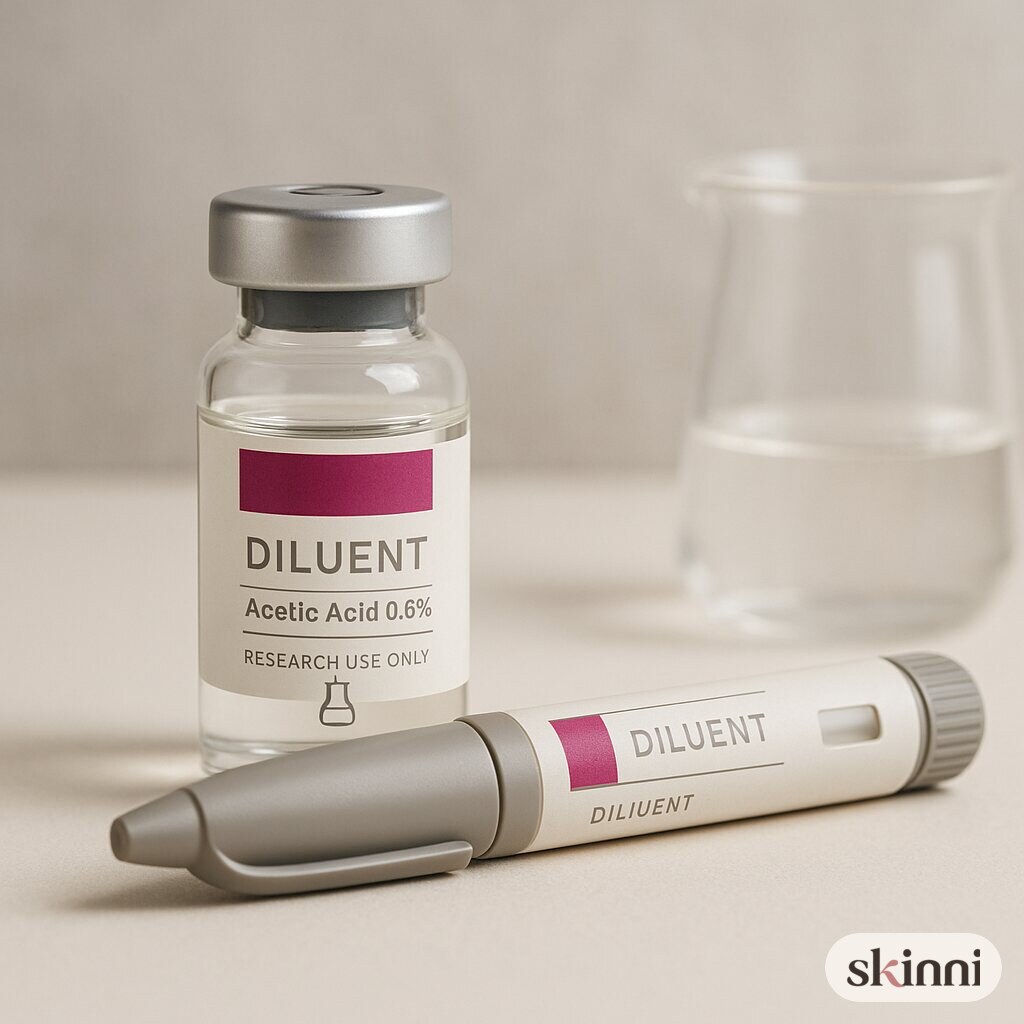
About this compound
A 0.6% v/v solution of glacial acetic acid in laboratory-grade purified water, supplied as a diluent for peptides that will not readily dissolve in neutral aqueous media.
Studied in
- Reconstitution
- Bench consumables
Compound identity
| Compound | Acetic Acid 0.6% |
|---|---|
| CAS number | 64-19-7 |
| Molecular formula | CH3COOH |
| Molecular weight | 60.05 Da |
Specifications
- Purity method: HPLC
- Appearance: Lyophilized powder
- Solubility: Reconstitute per protocol; see Supplies for diluents.
- We don't publish a purity percentage here — that figure is only meaningful tied to the lot you actually receive, so it lives on the lot certificate.
Supplies
DILUENT
Acetic Acid 0.6%
Dilute acetic acid, supplied as a reconstitution solvent.
What the research targets
A bench consumable, not a research compound: supplied as a diluent for peptides with poor solubility in bacteriostatic water.
Supply formats
Single units ship from stock. Cases are back-ordered against the same single-unit price.
Single unit
Sample quantity — one unit.
10 mLVial
PS-2200418-10-ML
On verified account
Case — back-order
Ten of one size, at 10× volume pricing.
Case · 10 × 10 mL
Back-order — 15% off the single-unit price.
PS-2200418-C10-10-ML
On verified account
One-time verification of professional or institutional affiliation. No payment is taken on this site.
Research use only
This compound is supplied exclusively for laboratory research by qualified professionals and institutions. It is not a drug, dietary supplement, or cosmetic, and is not for human or veterinary use. We publish no dosing, administration, or human-use guidance of any kind, and nothing here should be read as a claim about an effect in people.
From the research library
Cited summaries of the published work behind Acetic Acid 0.6% — what was studied, in which model, and what was measured.
Supplies
Handling lyophilised peptides at the bench
Freeze-drying buys stability and introduces its own failure modes. Most degradation in practice happens before an experiment starts.

Supplies
How to read a certificate of analysis
What HPLC purity, mass-spectrometric identity, water content and endotoxin figures each tell you — and the several things a COA cannot tell you at all.