A bench-practice article on the part of peptide work that gets least attention and causes most irreproducibility.
In short
- Lyophilisation removes water by sublimation under vacuum, leaving a solid that is far more stable than a solution but strongly hygroscopic.
- Equilibrating a vial to room temperature before opening is the single most consequential handling step, because condensation onto cold powder introduces the water that drives hydrolysis.
- Sequence composition predicts the likely failure mode: methionine, cysteine and tryptophan oxidise; asparagine and glutamine deamidate; aspartate-glycine and aspartate-proline sites are hydrolysis-prone.
- Repeated freeze-thaw cycling of reconstituted material is a documented source of loss, which is the argument for single-use aliquots.
What freeze-drying does and does not fix
Lyophilisation freezes an aqueous peptide solution and then removes the ice by sublimation under vacuum, leaving an amorphous solid. The gain is straightforward: water is the reactant in hydrolysis and the medium for most other degradation chemistry, so taking it away slows nearly everything down. A properly dried and sealed peptide is stable for extended periods at low temperature where the same peptide in solution would degrade in weeks.
What it does not fix is hygroscopicity. The resulting cake has high surface area and pulls moisture from the atmosphere readily, and residual water in the solid is the starting point for degradation during storage. This is why the handling sequence matters as much as the storage temperature.
The condensation problem
A vial taken from a freezer and opened immediately is well below the dew point of room air. Water condenses onto the powder, and the peptide is now sitting in the presence of the reactant that lyophilisation was performed to remove. Nothing about that event is visible, and the effect appears later as an unexplained loss of activity or a new peak on a chromatogram.
The standard practice follows from the mechanism: allow the sealed vial to equilibrate fully to room temperature before breaking the seal, minimise time open, and where the material is genuinely sensitive, work under dry gas. Weigh at room temperature, not straight out of cold storage.
The corollary is that storage temperature alone is an incomplete specification. Long-term storage of lyophilised material at minus twenty degrees or below, protected from light, is the usual recommendation; how the container is brought back up matters as much as how far down it went.
Sequence predicts the failure mode
Degradation is not generic, and the sequence indicates what to expect. Methionine, cysteine and tryptophan are oxidation-prone, which makes light exclusion and headspace composition relevant. Asparagine and glutamine deamidate, a pH-dependent reaction that changes mass by one dalton and is therefore detectable by mass spectrometry if anyone looks. Aspartate-glycine and aspartate-proline sequences are susceptible to backbone cleavage. Cysteine-containing peptides can form intermolecular disulfides and aggregate.
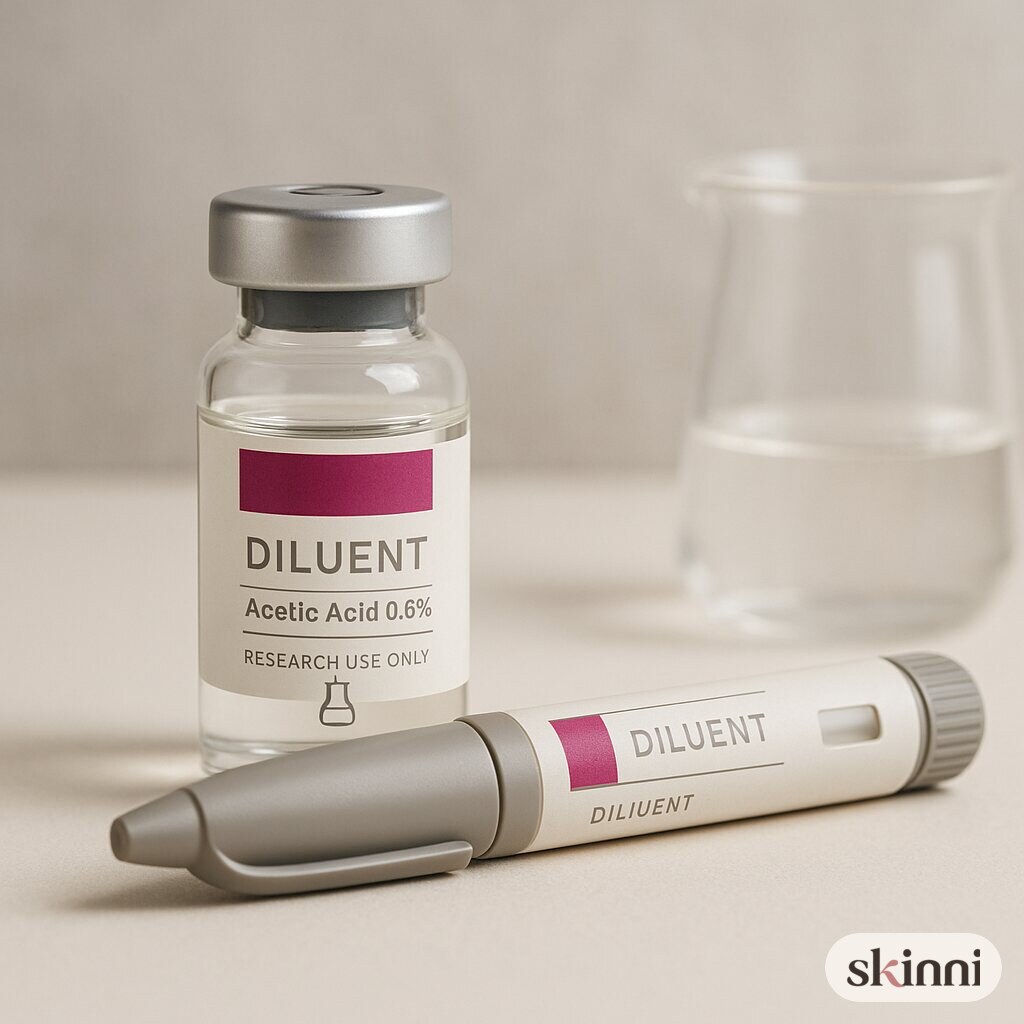
pH is the main solution-phase lever. Most peptides are more stable in mildly acidic conditions than at neutral or alkaline pH, which is part of why dilute acetic acid appears as a reconstitution solvent for material that is poorly soluble in water alone. Solvent choice is a solubility and stability decision jointly, and the appropriate choice differs by sequence.
After reconstitution
Once in solution, the clock speeds up considerably. Two practices follow. First, aliquot into single-use volumes immediately rather than returning a stock vial to the freezer repeatedly — freeze-thaw cycling is a documented cause of loss through aggregation and adsorption, and each cycle costs material. Second, record the date, solvent and concentration on every aliquot, because a solution of unknown age is an uncontrolled variable and will eventually be the reason an experiment does not reproduce.
Adsorption to container surfaces is worth noting for dilute solutions of hydrophobic peptides: measurable quantities can be lost to plastic, which at low concentrations is a real fraction of the total.
None of this is difficult. It is simply the part of the work where reproducibility is usually lost, and it is invisible in any published method section that says only that material was stored at minus twenty degrees.
References
- Manning MC, Chou DK, Murphy BM, Payne RW, Katayama DS. Stability of protein pharmaceuticals: an update. Pharmaceutical Research. 2010;27(4):544–575.
- International Council for Harmonisation. ICH Q1A(R2) Stability Testing of New Drug Substances and Products. ICH Harmonised Tripartite Guideline.
What this article is, and is not
This is a summary of published research, written for qualified professionals evaluating compounds for laboratory work. Every compound discussed is supplied by strictly for in-vitro and laboratory research use. None is a drug, a dietary supplement, or a cosmetic; none is intended for human or veterinary use; and nothing above is medical advice, a treatment recommendation, or a claim that any compound produces any effect in a person. We publish no dosing or administration guidance of any kind.