An account of the matrikine hypothesis and the gene-expression work that gave it a concrete example.
In short
- Matrikines are peptide fragments released when extracellular matrix proteins are degraded, which then act as signalling molecules in their own right.
- GHK is a tripeptide — glycyl-L-histidyl-L-lysine — first isolated from human plasma and later identified in collagen sequence.
- Its behaviour in the literature is inseparable from copper: the histidine imidazole and adjacent nitrogens coordinate Cu(II), and the complex is the studied entity.
- Pickart and Margolina's 2018 review collates gene-expression datasets in which GHK-Cu exposure was associated with broad transcriptional shifts in cultured human cells.
Degradation products that carry information
The extracellular matrix was long treated as scaffolding — collagen, elastin, proteoglycans, laid down and then inert. That account is no longer tenable. When matrix proteins are cleaved by matrix metalloproteinases during remodelling, the fragments released are not uniformly inert debris. Some bind cell-surface receptors and change fibroblast and keratinocyte behaviour. The term matrikine names this class.
The logic is economical. A tissue undergoing damage generates degradation products in proportion to the damage; if those products signal, the tissue has a built-in report on its own state that requires no separate messenger. The best-studied examples span collagen-, elastin- and laminin-derived fragments.
GHK, and why copper is not a detail
Glycyl-L-histidyl-L-lysine was isolated from human plasma in the 1970s by Loren Pickart, who reported that the fraction containing it altered the behaviour of cultured hepatocytes. The sequence subsequently turned up within type I collagen, which is what connects it to the matrikine framework: it is a fragment that matrix degradation would liberate.
Copper coordination is central rather than incidental. The histidine imidazole nitrogen, together with the adjacent backbone nitrogens, forms a high-affinity site for Cu(II). In the literature the studied species is almost always the complex, GHK-Cu, and one reading of the peptide's activity is that it functions substantially as a copper delivery vehicle — copper being a required cofactor for lysyl oxidase, which cross-links collagen, and for superoxide dismutase.
This makes the free peptide and the complex genuinely different experimental objects, a distinction that commercial writing on the subject tends to collapse.
The gene-expression datasets
The most-cited body of work is transcriptional. Pickart and Margolina, writing in the International Journal of Molecular Sciences in 2018, assembled published microarray and expression data in which cultured human cells exposed to GHK-Cu showed altered expression across a large number of genes, with the reported shifts concentrated in matrix remodelling, antioxidant response and DNA repair categories.
Two cautions belong with that summary. Broad transcriptional change in culture is a description of what a cell did in a dish, not a demonstration that a tissue was remodelled; and expression-level analyses of this kind are hypothesis-generating by nature. The 2018 paper is a review collating existing datasets rather than a controlled trial, and the authors have a long-standing research association with the compound.
What the work does establish is that the molecule is transcriptionally active in cultured human cells at low concentrations, which is a more specific and more interesting claim than the marketing version of it.
Where the catalog sits relative to this
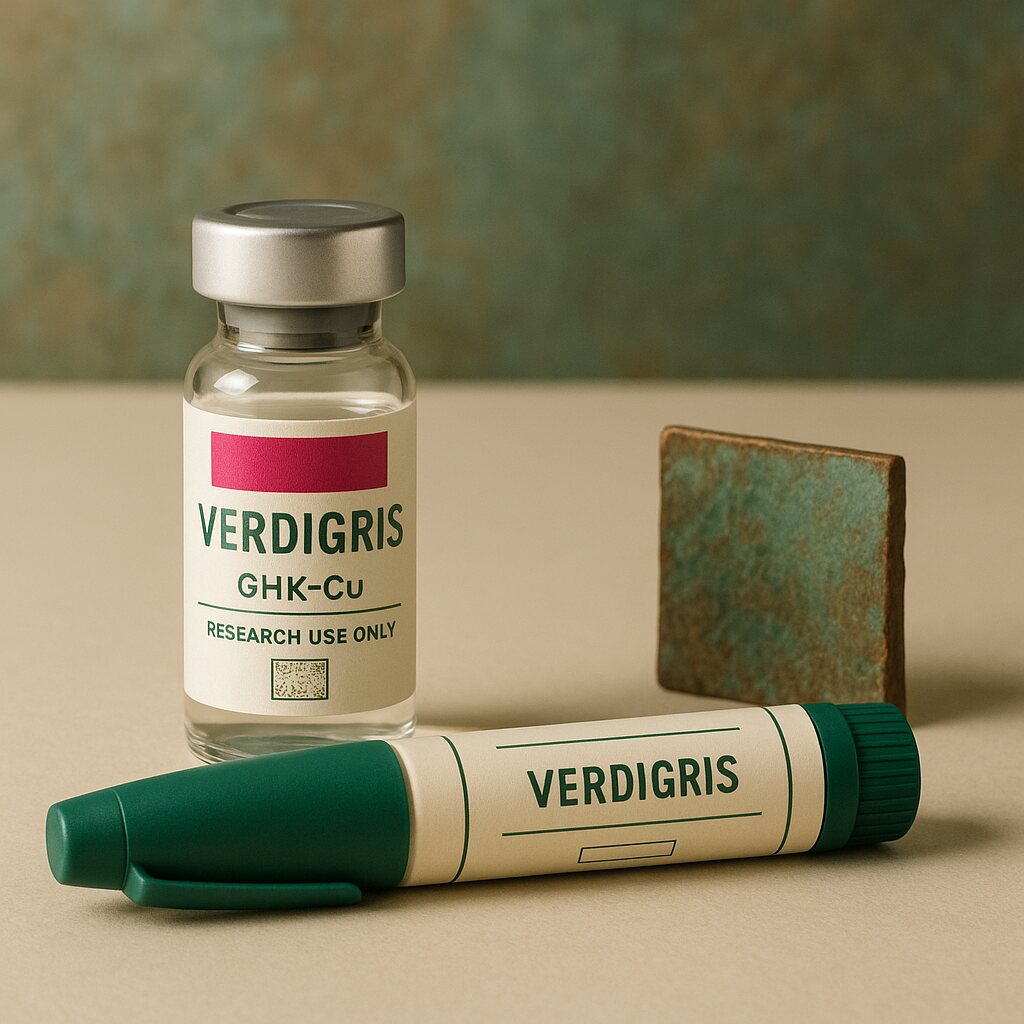
GHK-Cu appears in the Regenerative world on this site as a research compound, and two blend entries include it alongside other sequences. The research targets named on those pages are matrix protein expression, fibroblast behaviour in culture, and copper-dependent enzyme activity — the questions the literature above actually asks.
They are not statements about skin, appearance or age in a person. No controlled human trial establishing such an outcome is cited here, because the ones that would be needed have not been run at the standard that would justify the claim.
References
- Pickart L, Margolina A. Regenerative and Protective Actions of the GHK-Cu Peptide in the Light of the New Gene Data. International Journal of Molecular Sciences. 2018;19(7):1987.
What this article is, and is not
This is a summary of published research, written for qualified professionals evaluating compounds for laboratory work. Every compound discussed is supplied by strictly for in-vitro and laboratory research use. None is a drug, a dietary supplement, or a cosmetic; none is intended for human or veterinary use; and nothing above is medical advice, a treatment recommendation, or a claim that any compound produces any effect in a person. We publish no dosing or administration guidance of any kind.