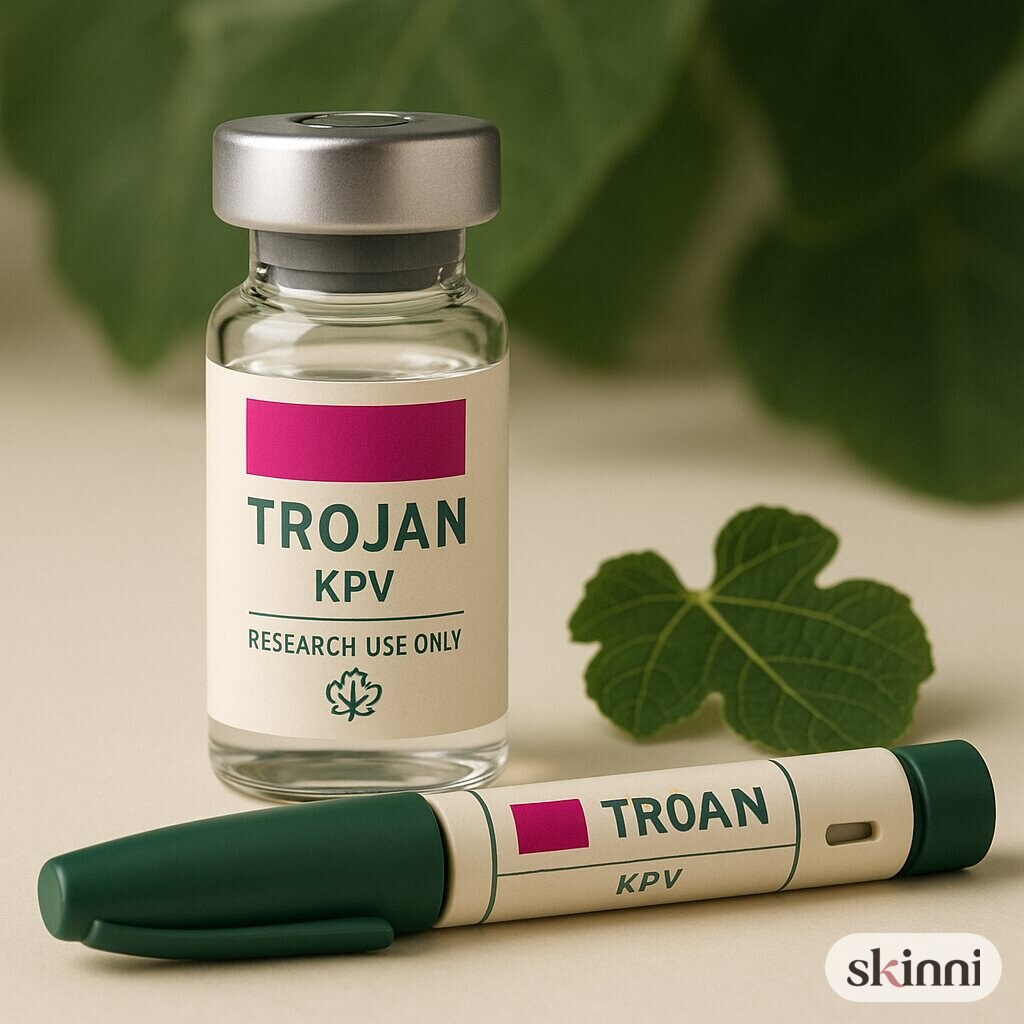
A short article on a short peptide, and on why its transport route is more than a pharmacokinetic footnote.
In short
- KPV — lysine-proline-valine — is the C-terminal tripeptide of alpha-melanocyte-stimulating hormone.
- Dalmasso and colleagues reported that its uptake in intestinal epithelium is mediated by the di- and tripeptide transporter PepT1.
- PepT1 expression in colonic epithelium is low normally and upregulated in inflammation, which makes the transporter route mechanistically interesting rather than incidental.
- The work is in cell culture and in mouse colitis models. There is no controlled human trial.
A fragment of a melanocortin
Alpha-melanocyte-stimulating hormone is a thirteen-residue peptide best known for pigmentation signalling through the melanocortin-1 receptor, and separately documented as an anti-inflammatory mediator. Its C-terminal three residues, lysine-proline-valine, retain a portion of the anti-inflammatory activity in published assays while carrying essentially none of the pigmentation signalling.
That dissociation is what makes the fragment a distinct research object rather than a degradation product. It is also a good illustration of a general point from the fundamentals article: a fragment is a different molecule from its parent, and which activities survive truncation is an empirical question, not a deduction.
The transporter is the mechanism
Dalmasso and colleagues reported in Gastroenterology in 2008 that KPV uptake into intestinal epithelial cells is mediated by PepT1, the proton-coupled transporter that normally carries di- and tripeptides from digested protein. In the models used, uptake was reduced when PepT1 was absent or inhibited, and the associated reduction in inflammatory markers tracked with it.
The reason this matters beyond pharmacokinetics is the expression pattern. PepT1 is abundant in small intestine and low in healthy colon, but is upregulated in colonic epithelium under inflammatory conditions. A compound that depends on PepT1 for entry therefore enters preferentially where the transporter has been induced — which is an unusual and somewhat elegant form of localisation, and the reason the finding is cited more often for the transport route than for the anti-inflammatory readout itself.
The authors reported effects at concentrations well below those required for larger anti-inflammatory peptides in comparable assays, which they attribute to the active transport.
The limits, stated plainly
This is cell-culture and mouse work. Colitis models in mice are a standard tool and also a well-known source of findings that do not survive translation. No adequately powered controlled human trial of KPV for any indication has been published, and it is not an approved drug.
The compound appears in the Regenerative world on this site with mucosal inflammation in animal models and PepT1-mediated transport named as the research targets, which is the accurate description of what the literature contains.
References
- Dalmasso G, Charrier-Hisamuddin L, Nguyen HTT, et al.. PepT1-mediated tripeptide KPV uptake reduces intestinal inflammation. Gastroenterology. 2008;134(1):166–178.
What this article is, and is not
This is a summary of published research, written for qualified professionals evaluating compounds for laboratory work. Every compound discussed is supplied by strictly for in-vitro and laboratory research use. None is a drug, a dietary supplement, or a cosmetic; none is intended for human or veterinary use; and nothing above is medical advice, a treatment recommendation, or a claim that any compound produces any effect in a person. We publish no dosing or administration guidance of any kind.